

Sapim CX Sprint J Bend Bladed 14|21|14g - 2.25|1.25mm Spokes
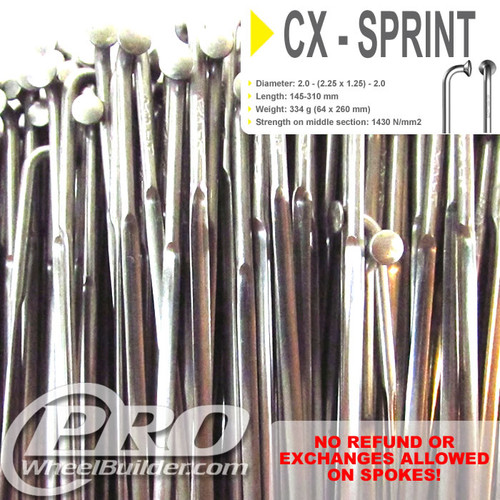
The Sapim CX-Sprint is the CX-Ray's bigger brother: a bladed aero spoke forged to a wider, thicker 2.25 x 1.25mm blade for riders and wheels that need more stiffness than the CX-Ray gives. Sprinters, heavy riders, low-spoke-count wheels on deep rims, hard-charging gravel and trail wheels and e-bikes all benefit from a CX-Sprint. It weighs about 334 grams per 64, has a middle-section strength around 1430 N/mm², and Sapim makes it in Belgium in J-bend and straight-pull.
This page covers the J-bend Sapim CX Sprint J Bend Bladed 14|21|14g - 2.25|1.25mm Spokes. We sell CX-Sprint spokes only as part of a wheel we build, cut to the exact length the rim and hub call for. Choose your rim, hub and nipples in the configurator and the wheel ships from Georgia laced, tensioned and trued by hand.
Design and construction
The CX-Sprint starts as a 2.0mm double-butted spoke drawn to the equivalent of 1.8mm in the middle, roughly a Sapim Race, which is then cold-forged into a 2.25 x 1.25mm blade. Compared with the CX-Ray's 0.9 x 2.2mm blade it has about 40% more cross-section, which is where the extra stiffness and strength come from. The blade still passes through a standard hub flange hole without slotting, and the threads are rolled so the steel's grain stays intact.
Like every Sapim blade, the CX-Sprint is easy to hold with a blade tool while the nipple turns, so there is no wind-up and the wheel builds true. Lengths run in even millimetres, in black or silver.
Sapim makes the CX-Sprint in lengths from about 200 to 310mm in even millimetres, J-bend and straight-pull, black or silver, and it takes any standard 14-gauge nipple; we use Sapim Polyax nipples, whose rounded seat lets the spoke find its own line into the rim.
How it rides
A CX-Sprint wheel is firmer than a CX-Ray wheel and you feel it in a sprint or a hard corner: less lateral give, more direct. On a deep carbon rim with 20 or 24 spokes it is the spoke that keeps the wheel from feeling vague under a powerful rider. On a trail or e-bike wheel it adds a margin of strength without going to a heavy round spoke.
For lighter riders and higher spoke counts the CX-Ray is more comfortable and lighter; the CX-Sprint is the blade for load.
We see the CX-Sprint most on 50mm-plus carbon road rims with 20 to 24 spokes, where a lighter blade lets the rim wander under a big rider, and on enduro and e-MTB wheels where the customer wants a blade for looks and truing but needs the strength of a Race. In both cases it is the right call, and the extra gram per spoke is not something anyone has ever felt.
Specifications
| Gauge | 14/21/14G |
|---|---|
| Profile | Bladed |
| Material | Stainless Steel |
| Spoke head | Jb-b |
| Finishes | silver, black |
This version
This listing is the J-bend version in a 14/21/14g butted section, flat-forged into a blade. A J-bend spoke has the elbow formed into the head and drops through a drilled flange, which is the older and far more common pattern. It fits almost any hub, replacements can be found in any decent shop anywhere in the world, and the elbow is the part that eventually fails - which is why it is seated properly and the wheel stress-relieved before it leaves us. If your hub has drilled flanges, this is the one you want.
Sizes, fit and compatibility
The Sapim CX Sprint J Bend Bladed 14|21|14g - 2.25|1.25mm Spokes is cut to length for your build; the configurator reads the rim's ERD and the hub's flange dimensions and works out the length. J-bend CX-Sprints fit any standard J-bend hub in the catalog.
We pair CX-Sprint spokes with brass Sapim Polyax nipples on e-bike, trail and carbon-rim wheels and alloy Polyax nipples on lighter road builds; the configurator offers both.
How Sapim makes its spokes
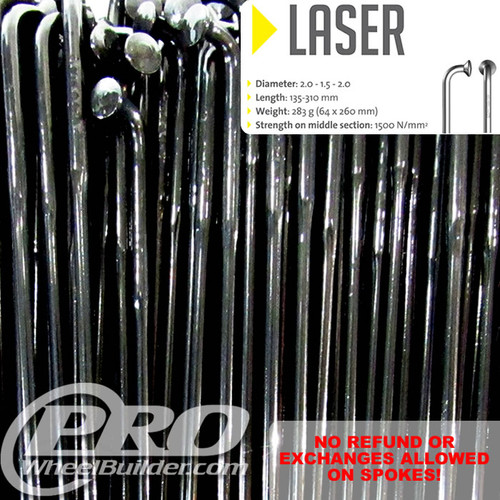
Sapim has been drawing spoke wire in Belgium since 1918, and the range is built around one idea: the same wire and the same head, drawn to different middles. A Leader is 2.0 mm all the way through. A Race is 2.0 mm at the ends and 1.8 mm in the middle. A Laser takes the middle down to 1.5 mm. A CX-Ray is a Laser that has then been flat-forged into a blade, which is why it is light and aerodynamic without being a fragile spoke. Every one of them keeps a full-diameter head and thread, because those are the two places a spoke actually fails.
Some years ago a graduate student at Georgia Tech pulled five spokes to failure on a tensile tester, five samples of each, for Snyder Cycles. Snyder has since closed; we asked for permission to use the footage and were given it. It is worth more than a test we could run ourselves, because nobody in it was selling spokes. The averages line up like this: Sapim Race 303.15 kgf, Sapim Leader 299.37 kgf, DT Swiss Champion 289.80 kgf, DT Swiss Competition 276.95 kgf. The two pairs worth reading are the like-for-like ones. Among the plain-gauge 2.0 mm spokes, Sapim Leader averaged about 3% above DT Champion, and its weakest sample still pulled higher than DT's strongest. Among the double-butted spokes, Sapim Race averaged about 9% above DT Competition. Where they broke is as interesting as the number: the Race failed at the J-bend head, which is where a spoke is expected to go, while the Competition failed at the outer butting transition.
Treat it as what it is. One test, five pulls per spoke, measuring yield load on a straight pull in a machine rather than a laced wheel under a rider - and it does not capture fatigue life, which is what actually ends most spokes in service. It is also not new; it predates Snyder closing. But it is a real measurement, on real samples, by someone with nothing to sell, and it is part of why Sapim is what we reach for.
An independent spoke strength test
The manufacturing detail above comes from the maker. The choice of spoke for a given build is ours, and we will explain it if you ask.
Building it at ProWheelBuilder
Sapim makes the CX-Sprint in Belgium; ProWheelBuilder is an independent wheel builder in Georgia, not the manufacturer. We cut CX-Sprint spokes from the measured ERD of the rim in hand, lace the wheel by hand, hold every blade straight as we bring the tension up with a gauge, stress-relieve it and true it before it ships.
The configurator recommends a spoke gauge and count from your bike type and weight, and only shows spokes that fit the hub you choose.
The nipple matters as much as the spoke. Brass is heavier, but it does not corrode, it does not round off under a spoke wrench after five years, and it is kinder to a carbon rim bed than alloy. Alloy nipples save about 30 grams a wheel and are the right choice on a race wheel that is kept clean. We stock both in every color the configurator offers and we tell you which we would use.
CX Sprint J Bend Bladed 14|21|14g - 2.25|1.25mm Spokes questions
Should I take this in J-bend or straight-pull?
Whichever your hub takes - it is decided by the hub, not by preference. A J-bend spoke drops through a drilled flange and is what the large majority of hubs use, which also makes a replacement easy to find anywhere. If your hub holds the spoke head directly with no drilling, you need the straight-pull CX-Sprint, which is a separate listing.
CX-Sprint or CX-Ray?
CX-Sprint for heavy or powerful riders, low spoke counts, deep rims, hard trail use and e-bikes; CX-Ray for most other riders and wheels, where it is lighter and a little more comfortable.
Is the CX-Sprint e-bike rated?
Yes. It is one of the bladed spokes we recommend for e-bikes, paired with brass nipples.
Does the CX-Sprint fit standard hubs?
Yes. The blade passes through a standard flange hole; the configurator only shows compatible spokes for the hub you pick.
How much heavier is the CX-Sprint than the CX-Ray?
About a gram per spoke: roughly 334g versus 272g per 64 spokes.
Do I choose the spoke length?
No. The configurator calculates the length from the rim's ERD and the hub's flange geometry; we cut and thread the spokes here.
Which spoke should I pick?
The configurator recommends a spoke from your bike type, rider weight and rim; a stronger spoke is offered when the build calls for it.
Not sure? Email info@prowheelbuilder.com (fastest) or leave a voicemail on 470-253-0929 — you will be talking to the people who build the wheels.